
About University Regulations
About The Regulations Library
Types of University Regulations
The University Regulations Library is the repository for university regulations and includes the following types of regulations:
- Policy: A general statement that addresses the governance, philosophies, principles, or broad concepts inherent in carrying out the missions of the University
- Rule: Either a general statement governing university operations or may provide interpretative direction of a university policy
- Procedure: Establishes the steps necessary to appropriately and uniformly perform a task to carry of the external business or internal activities of the university
- Guideline: Practical information or other guidance that may be useful to persons in carrying out their individual responsibilities in accord with university regulations.
Policies, rules, and procedures are binding on all members of the university community. Guidelines are best practices and recommendations. All University policies and rules are published in the Regulations Library. Many procedures and guidelines are also published in the Regulations Library. Supplemental rules, which apply only to a single subdivision of the university, generally are not published in the Regulations Library.
Numbering of University Regulations
Each regulation has a number that the describes the type of regulation it is, the
part of the Regulations Library it belongs in, and for a regulation other than a policy,
the associated policy.
University Regulations in Context
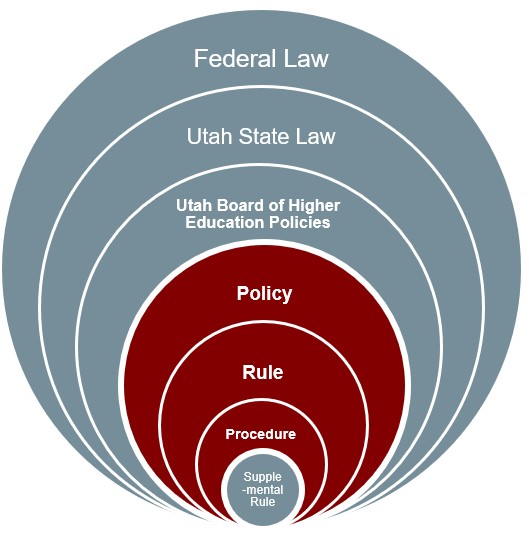
As a public institution of higher education, the university is subject to a complex
hierarchy of federal law, state law, and Utah Board of Higher Education Requirements.
University regulations must comply with these requirements. Individual unit policies
that apply just to that unit (for example a college's policies) may not conflict a
university regulation. This images shows how university regulations fit in this overall
regulatory structure.
Archival Information about University Regulations
Each policy or rule page includes a "History" section with archival information about the policy or rule. The archival information includes previous versions of the policy or rule, and, in some cases, legislative history summaries describing the changes to the policy or rule over time. For assistance with archival information, please contact the University Regulations Office.
The University Regulation Revision Process

Notification and Preparation
Notify the Regulations Office of the proposed policy/rule change
The Regulations Office provides the Microsoft Word version of the regulation and can provide assistance with managing the regulation revision process
Regulation Development and Drafting
Determine the details of the change you want to make and conduct research
Coordinate with others who will be involved in drafting and make sure you have support from unit's leadership
Draft the regulation revisions using track changes to show additions and deletions
Have the proposed regulation change reviewed by university stakeholders and groups, including the Institutional Policy Committee for major revisions, and incorporate feedback
Receive approval from vice president or designee over policy area to move the regulation through the formal review and approval process
Formal Review and Approval Process
Present final proposed revision to the Institutional Policy Committee
Consult with Academic Senate
Present policies/rules related to requirements for admission, degrees, or certificates
or course curriculum and instruction for a recommendation of approval
Present other policies/rules in the Regulations Library Part 6: Academics or Part
7: Research, for a recommendation of approval or for information, if requested by
the president
Present all other policies/rules for information, if requested by the president
All policies are recommended by the president and receive final approval from the Board of Trustees
All rules receive final approval by the president, vice president, or designee
Publication and Implementation
Regulations Office publishes revised regulations on regulations.utah.edu and distributes a notice of a recently revised regulation
Communicate regulations changes to campus community and update forms, processes etc.
Monitor implementation and propose additional revisions as needed
Frequently Asked Questions
Please review the Resources for Regulation Writers. To start a regulation revision, please contact the University Regulations Office. If you are not the policy owner, it is also a good idea to reach out to the policy owner to talk about your proposed changes.
Each regulation lists a “policy owner” who is the contact person for questions about that regulation. Policy owners are listed by position, rather than name, so you will need to find the person who currently holds that position for the university.
All university regulations are available in the Regulations Library, which is a comprehensive list of all regulations and includes a search bar. Each regulation also includes a list of related regulations. If you can't find the regulation you're looking for, please contact the University Regulations Office for help.
The university uses a shared governance model to receive input from members of the university community on drafting proposed regulations. Policy 1-001: Policy on University Regulations, describes the different types of university regulations and their approval processes.
The university has three types of regulations: policies, rules, and procedures. Policy 1-001: Policy on University Regulations, defines these different types of regulations. A policy is “a general statement addressing governance, philosophies, principles, or broad concepts inherent in carrying out the missions of the university.” A rule is either a general statement governing the operations of the university or “may provide more specific interpretive direction where University policies are silent, vague or flexible.” A procedure “sets forth the steps necessary to appropriately and uniformly perform a task to carry out the external business or internal activities of the University.” Polices, rules, and procedures are binding to the university community. The Regulations Library also includes guidelines, which are nonbinding and “provide practical information or other guidance that may be useful to persons carrying out their individual responsibilities.” For more information, see About University Regulations.
Establishing or revising a university regulation involves an extensive review and approval process. In some cases, such as when a federal or state law changes, the University needs to revise or enact regulations quickly, and in these cases, the University may issue an interim regulation. Interim regulations are intended to be temporary and go through the full review and approval process to become a final regulation within a certain time period after the interim regulation takes effect.
The IPC facilitates the development, review, distribution, and maintenance of University regulations by overseeing the general content, structure, publication, and coordination of University policies and rules, and, in certain cases, procedures and guidelines. Members of the IPC are appointed by the University president and represent various divisions of the University. See Resources for Regulations Writers for more information about the IPC and a list of current members.
Each regulation in the Regulations Library includes archival information, such as PDFs of versions of the regulation that were previously in effect and “legislative history” documents that describe how the policy was changed and the reasons for the changes. You can also contact the policy owner for information about the policy.
The University of Utah uses a shared governance model, and draft regulations are often reviewed by various committees and groups across campus throughout the drafting process. You can provide input through these committees as they review draft policies and rules. Major revisions often include more widespread consultation processes, such as town halls.
Please email regulations@utah.edu.